

From €90
< Back to show details
Maria Stuarda - Donizetti

Théâtre des Champs-Elysées - Paris

Select the date of the show

Loading available dates...

Additional offers

Restaurant Bar des Théâtres €42 per person More information
0
Please specify your seating requests regarding your ticket booking (OPTIONAL).
(100 char. max)

Seating

Music & Opera books the best available seats. The exact location of your seats will be confirmed via email. Only adjacent seats can be booked. More information

ANY QUESTIONS ?

Contact us by tel: +33 1 53 59 39 29 – or by Email.) See Help & FAQ page

TICKET DELIVERY INFORMATION

You will receive by mail your voucher to print and exchange at the theater.

Price

Music & Opera ticket prices differ from the ticket face value, as they also include all service fees and taxes.

The Club Music & Opera

Le Club Music & Opera
Join the Club to benefit from special offers. Already Member of the Club, Login !
Maria Stuarda - Donizetti

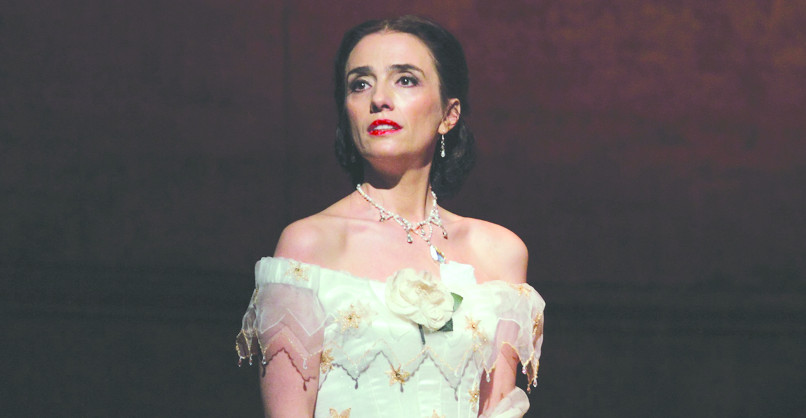
Jaho Ermonela © Ashmore Catherine - Royal Opera House

Donizetti Maria Stuarda

The 01 April 2027
Théâtre des Champs-Elysées - Paris
From 90 €
Prices & Dates
Program

Donizetti : Maria Stuarda

Sung in : Italian
Cast
  • Orchestre de chambre de Paris
  • Conductor
    Clelia Cafiero
  • Director
    Concert Version
  • Performers
    Maria Stuarda: Ermonela Jaho
    Elisabetta: Marina Viotti
    Leicester: Levy Sekgapane
    Talbot: Michele Pertusi
    Lord Cecil: Lodovico Filippo Ravizza
    Anna Kennedy: Marine Chagnon
  • Venue Info
  • Seating Plan
  • Synopsis

Théâtre des Champs-Elysées - Paris Location15 Avenue Montaigne - 75008 Paris France

  • Venue's Capacity: 1985

The Théâtre des Champs-Elysées, initially planned for construction on the legendary avenue after which it was named, is in fact situated on Avenue Montaigne. It was in 1913 that the Parisian public first discovered the hall, an astonishing synthesis of tradition and modernity, with balconies that recall an Italian théâtre, while being supported by reinforced concrète, and with décoration at once sober and sumptuous. Speaking of eclecticism, the house's first season was quite surprising. THE BARBER OE SEVILLE was billed alongside BORIS GODUNOV, and it was here that Stravinsky RITE OF SPRING was premiered, provoking an infamous scandai. Nijinsky counted behind the scènes for the dancers in Russian, while Pierre Monteux kept time for the musicians, and Stravinsky ran back and forth between the stage and the audience, in an attempt to save the performance. After such an eventful start, the théâtre rapidely grew in réputation and Marcel Proust saluted Gabriel Astruc as being the manager «who staged BORIS GODUNOV, and who, in general, made up for the weaknesses of the Opéra and the Comic Opéra .»

After the First World War, concerts, opéras and ballets alternatively shared the programme, a tradition that still reigns today. Mozart's opéras were quite frequently staged, and performed by the visiting Vienna Opéra in 1924, 1947, 1949, and 1951. But the house also nurtured an affi-nity with Wagner's music; the Bayreuth troupe (with Lauritz Melchior) performed the entire Ring on the Champs-Elysées stage in 1929, and Furtwangler conducted the Walküre here in 1937.

Since the production of Boris Godunov that so enthused Marcel Proust, the théâtre also maintains close ties with the Russian réper­toire. After the bass Chaliapin and the Belgrad and Sofia Opéras, it is now the Kirov Théâtre from Saint Petersburg that regularly brings down the house.

More recently, the Champs-Elysées proposed Rimski-Korsakov's somewhat forgotten opéras in a séries of programmes that subtly mingled young talent with the grand tradition of the Vienna Philharmonie, in a concert hall entirely refurbished in 1986-87. Now equipped with a completely modernized stage machinery, the théâtre hasrevived the splendour of bygone days.
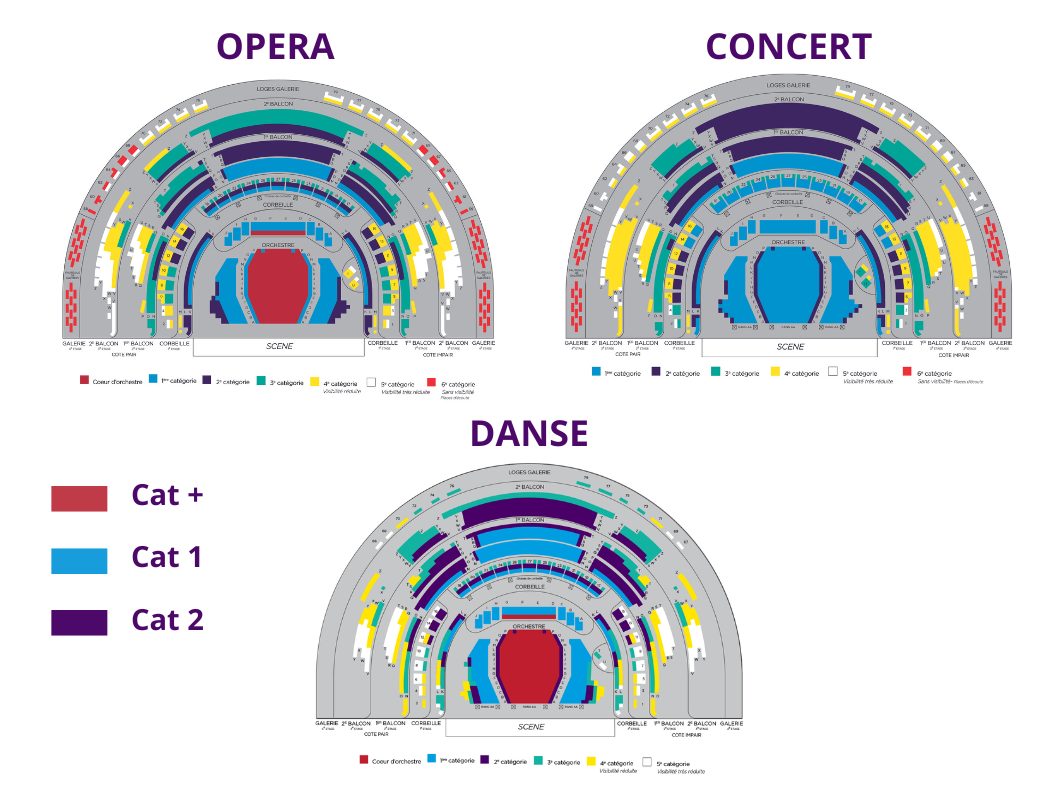

Théâtre des Champs-Elysées

The seating plan is given as an indication and has no contractual value.
The division of categories may differ depending on shows and dates.

Synopsis

Maria Stuarda

QUEENS AT ODDS: THE STORY OF MARIA STUARDA

HISTORY

Maria Stuarda is a tragic opera by Gaetano Donizetti based on the translation of Friedrich Schiller's 1800 play titled Maria Stuart, a story based on the lives of Mary, Queen of Scots, and her cousin Queen Elizabeth I. Maria Stuarda is one of Donizetti's operas which focus on the Tudor and Stuart period. The opera was first performed on December 30, 1835 at La Scala, Milan.

Act 1

Within the palace walls, the Queen of England, Elisabetta considers the King of France's marriage proposal. This is a perfect match politically for her subjects. For her on the other hand, such a union won't be perfect as she finds herself longing for the Earl of Leicester, Roberto. Talbot arrives on behalf of Maria, her cousin and the Queen of Scotland, to seek for mercy after Maria once tried to take the English throne. To make matters worse, Roberto is in love with Maria. To test how much Roberto loves Maria, Elisabeta requests him to deliver a ring to the King of France to signify the acceptance of the marriage proposal. Roberto obeys the order, which only confirms his love towards Maria.

Roberto leaves and is approached by Talbot, who gives him a picture of Maria along with a letter requesting for a meeting with Elisabetta. Vowing to do anything for Maria, Roberto agrees to have a conversation with the Queen of England on the behalf of Maria. When he returns, Roberto talks with Elisabetta who agrees to meet with Maria despite some hesitation.

Act 2

Maria wanders through the park outside Fotheringay Castle accompanied by her nurse, Anna. She reminisces about her youthful days and the joys of her limited freedom after being imprisoned. Horns sound in the distance announcing the Queen's arrival. Maria gets anxious and reconsiders meeting Elisabetta, but before she can make her exit, Roberto enters and encourages her to stay.

The two queens meet. It becomes clear that they both have reservations and resentment towards each other. Elisabetta was encouraged prior to the meeting by her councilors to have Maria executed, but she turned the suggestion down. However, she is furious that Roberto is defending Maria with immense devotion. Maria tries to remain calm as Elisabetta throws multiple insults at her. Maria responds by calling Elisabetta an illegitimate child who has no right to the throne. Elisabetta gets angry and tells her to prepare for her death.

Act 3

Queen Elisabetta hesitates to sign Maria's death warrant. She fears for her reputation and public reaction. Her councilors on the other hand try to convince that Maria's death is for the good of the kingdom and her safety. She hesitates despite the pressure. However, jealousy drives her to sign the death warrant, an action she takes when Roberto comes in pleading for Maria.

Maria refuses to see a priest when she is brought to the gallows. However, realizing that the end of her days is at hand, she confesses her wrong doings to Talbot. Before she is executed, she prays for Roberto, Elisabetta, and England.

THE MAIN ROLES

Maria Stuarda, Queen of Scotland, Soprano
Anna, Maria's companion, Mezzo-soprano
Roberto, Earl of Leicester, Tenor
Elissabetta, Queen of England, Soprano
Talbot, Earl of Shrewsbury,Bass

Paris - Théâtre des Champs Elysées - Intérieur

You may also be interested by …

Pay in 3 installments 30,00€ with interest-free. Learn more