

From €215
< Back to show details
Die Zauberflöte - Mozart

Wiener Staatsoper - Wien

Select the date of the show

Loading available dates...


Seating

Music & Opera books the best available seats. The exact location of your seats will be confirmed via email. Only adjacent seats can be booked. More information

ANY QUESTIONS ?

Contact us by tel: +33 1 53 59 39 29 – or by Email.) See Help & FAQ page

TICKET DELIVERY INFORMATION

Your E-tickets to be printed will be sent by mail.

Price

Music & Opera ticket prices differ from the ticket face value, as they also include all service fees and taxes.

The Club Music & Opera

Le Club Music & Opera
Join the Club to benefit from special offers. Already Member of the Club, Login !
Die Zauberflöte - Mozart

Jessica-Pratt-photo-Benjamin-Ealovega

Mozart Die Zauberflöte

From 22 June TO 28 June 2026
Wiener Staatsoper - Wien
From 215 €
Prices & Dates
Program

Mozart : Die Zauberflöte 160 mn

Sung in : German
Cast
  • Conductor
    Ivor Bolton
  • Director
    Barbora Horáková
  • Performers
    Tamino: Pavol Breslik
    Pamina: Florina Ilie
    Papageno: Michael Nagl
    Königin der Nacht: Jessica Pratt
    Sarastro: Günther Groissböck
    Sprecher: Adrian Eröd
    Papagena: Ilia Staple
    Monostatos: Matthäus Schmidlechner
  • Venue Info
  • Seating Plan
  • Synopsis

Wiener Staatsoper - Wien LocationOpernring 2 - 1010 Wien Autriche

  • Venue's Capacity: 1709

The Vienna State Opéra is much more than just a local institution; it is a vital part of the city's identity and a national landmark.

As of the 17th century, the Hapsburgs lavishly patronized the opéra. Family members Ferdinand III and Leopold I composed for the théâtre, while Charles VI tried his hand at conducting the orchestra, and the Empress Maria-Theresa often mingled with the corps de ballet.

During the 19th century, the Karntnerthor-Theater was demolished and the présent building was constructed on the famous " Ring ". It was here that Mahler, with the help of the set designer Alfred RoUer, imposed a new style of performance, based on audacious stagings and a very précise interprétation ofthe score, which demanded countless rehearsals.

After the fall of the Hapsburgs, Richard Strauss took over the reins of the newly baptized Vienna State Opéra. Curiously enough, only one of Strauss'operas, THE WOMAH WITHOUT A SHADOW, was premiered in Vienna. Clemens Krauss and Karl Bôhm were to follow in his footsteps. Under Bôhm's direction, the Opera created its own Company, which was to serve as a model for several générations. Even the bombs that destroyed the opéra house in 1945 could not prevent singer s such as Elisabeth Schwarzkopf, Irmgard Seefried, Sena Jurinac or Erich Kunz from becoming legendary.

One musn't think that the Viennese applaud only their homegrown stars. In 1955, when Maria Callas came to sing LUCIA DI LAMMERMOOR in the reconstructed building with Karajan conducting, the public blocked traffic to pay tribute to the diva... in the street! Karajan succeeàed Karl Bôhm, and invited many international stars to corne sing on the Viennese stage. Works were henceforth sung in their language of origin, and coproductions with La Scala permitted the disco-very of voices such as that of Mirella Freni in LA BOHEME.

Ioan Holender has suceeded in deftly combining these international distributions with an ensemble System. He has scheduled many works never heard on the Viennese stage, which are now included in the Opera's répertoire, such as Verdi's JERUSALEM and Enesco's OEDIPE, furthering a policy instated under Claudio Abbado's brilliant direction. Whatever changes may now occur, the Opera will continue to stage at least 300 performances per season (an absolute world record ren-dered feasible thanks to the în-house technical crew, which hires no less than 250 people), and the public will continue to applaud the finest orchestra any amateur could wish for in the pit : the Vienna Philharmonie !
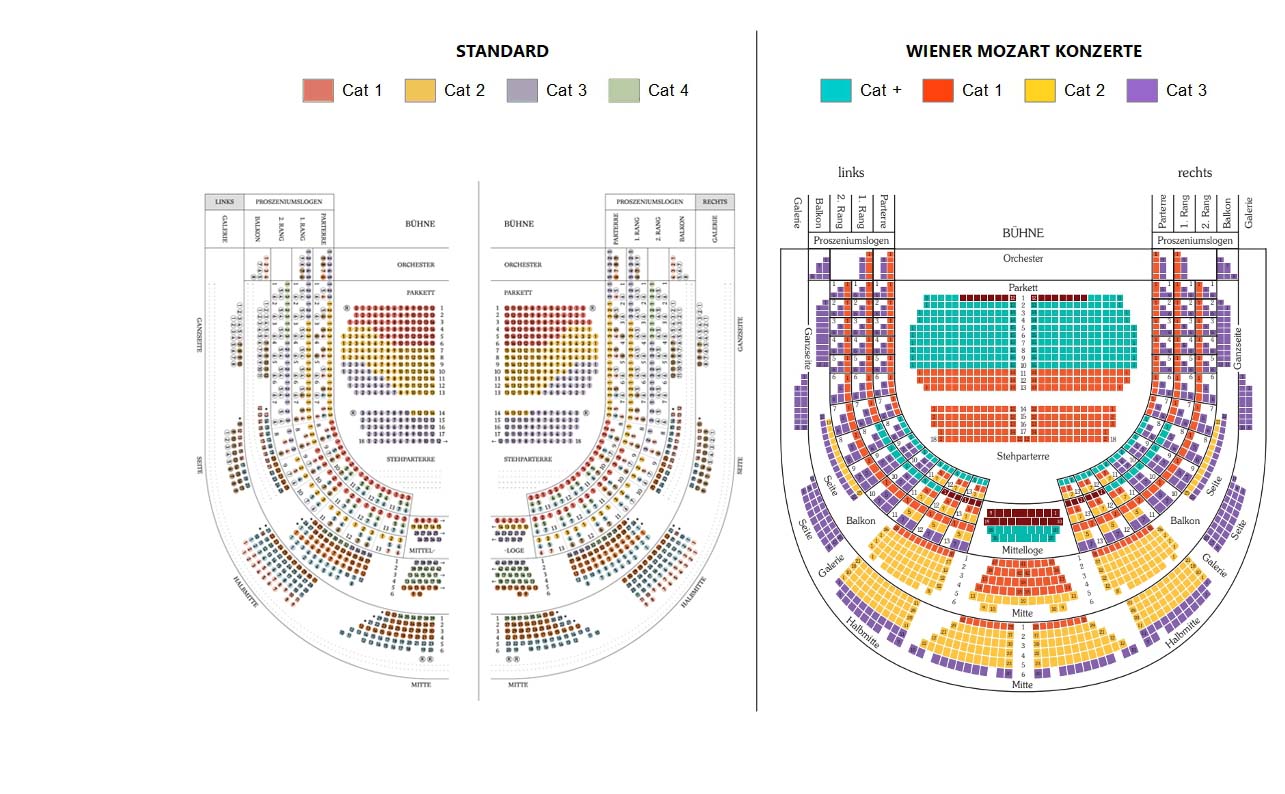

Wiener Staatsoper

The seating plan is given as an indication and has no contractual value.
The division of categories may differ depending on shows and dates.

Synopsis

Die Zauberflöte

Discover the upcoming dates for Mozart's opera The Magic Flute / Die Zauberflöte and reserve your tickets now.

THE MAGIC FLUTE, TRIUMPH OF THE INITIATIC TALE

Die Zauberflöte is an opera in two acts composed in 1791 by Wolfgang Amadeus Mozart, with a libretto by Emanuel Schikaneder. This opera is one of Mozart's greatest masterpieces and a high point of German opera, perfectly combining fantasy and Masonic symbolism.

Listen to the Music and Opera playlist: 

Created at the Vienna Theatre, The Magic Flute is both a philosophical tale and a popular opera, combining humour, magic and spiritual depth. It is an opera that remains a landmark, combining the marvellous with universal wisdom.

HISTORY

The plot tells the story of Prince Tamino, who is tasked with rescuing Pamina, the daughter of the Queen of the Night, who appears to be held captive by the wise Sarastro. Accompanied by Papageno, a mischievous bird catcher, Tamino must face a series of initiation trials. But as the story progresses, the roles of good and evil become blurred. Through these trials, Tamino and Pamina discover the true nature of wisdom and love, in a quest for truth that rises above deceptive appearances and conflicts.

THE MAIN CHARACTERS


  • Tamino, prince, tenor
  • Papageno, bird catcher, baritone
  • The Queen of the Night, soprano
  • Pamina, her daughter, soprano
  • Papagena, Papageno's betrothed, soprano
  • Sarastro, high priest of the kingdom of light, bass
Wiener Staatsoper © Michael Poehn

You may also be interested by …

Pay in 3 installments 71,67€ with interest-free. Learn more