

From €83
< Back to show details
Lucia di Lammermoor - Donizetti

Teatro Massimo - Palermo

Select the date of the show

Loading available dates...

Please specify your seating requests regarding your ticket booking (OPTIONAL).
(100 char. max)

Seating

Music & Opera books the best available seats. The exact location of your seats will be confirmed via email. Only adjacent seats can be booked. More information

ANY QUESTIONS ?

Contact us by tel: +33 1 53 59 39 29 – or by Email.) See Help & FAQ page

TICKET DELIVERY INFORMATION

You will receive by mail your voucher to print and exchange at the theater.

Price

Music & Opera ticket prices differ from the ticket face value, as they also include all service fees and taxes.

The Club Music & Opera

Le Club Music & Opera
Join the Club to benefit from special offers. Already Member of the Club, Login !
Lucia di Lammermoor - Donizetti

Teatro Massimo

Donizetti Lucia di Lammermoor

The 13 March 2027
Opening date: 01 December 2026
Teatro Massimo - Palermo
From 83 €
Prices & Dates
Program

Donizetti : Lucia di Lammermoor

Sung in : Italian
Cast
  • Conductor
    Stefano Ranzani
  • Director
    Lorenzo Mariani
  • Performers
    Lucia Ashton: Ruth Iniesta
    Sir Edgardo di Ravenswood: Marco Ciaponi
    Lord Enrico Ashton: Markus Werba
    Raimondo Bidebent: George Andguladze
    Lord Arturo Bucklaw: Didier Pieri
  • Venue Info
  • Seating Plan
  • Synopsis

Teatro Massimo - Palermo LocationPiazza Verdi - 90138 Palermo Italie

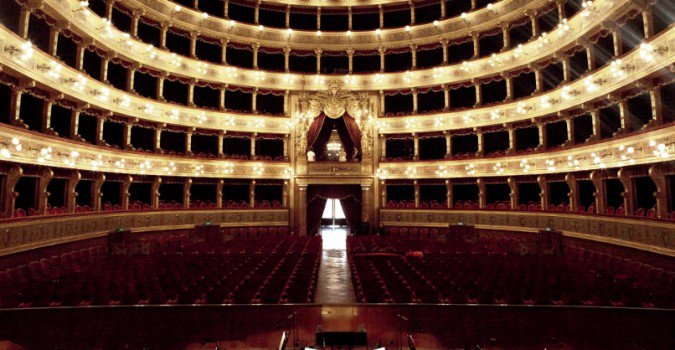
The history of the construction of the Teatro Massimo is almost as complicated as its reopening. As early as the end of the 18th century, Marquis Domenico Caracciolo lamented that Palermo did not have a lyrical theater befitting the hometown of Alessandro Scarlatti, the man who composed more than one hundred operas. Although the Teatro Carolino was built in 1801, it soon became too cramped and outdated, never suitable for the increasingly lavish productions of the Romantic era.

In 1844, the repertoire was still limited to Cimarosa, Mayr, Rossini, Donizetti, and Bellini. The "Carolino" was even renamed after the latter composer. While the "Bellini," thus named, continued to become outdated, it wasn't until 1851 that the construction of a new building was discussed, 1860 that the authorization appeared in the official journal of Sicily, and 1864 that an architectural competition was launched. Giovanni Battista Filippo Basile's project was chosen: at the architect's death in 1891, the Opera House was still not finished! Expropriating clergymen, solving technical problems, considering changing the project, and in the meantime, even building the Politeama for current performances all caused delays. It wasn't until 1897 that the "Massimo" finally opened its doors...

One could then applaud Enrico Caruso, a young and little-known tenor, on the theatre's stage, as well as singers such as Gigli, Stabile, and Gino Bechi, among the pride and joy of the Italian school. But it was only after the Second World War that the Massimo lived its heyday: conductors such as the young Giulini, Klemperer, and Scherchen came to lead the orchestra, Callas came to sing Brunnhilde and Norma, Sutherland was a revelation in the role of Lucia, while Szymanowski, Honegger, Dallapiccola and Stravinsky, amongst others, were performed....
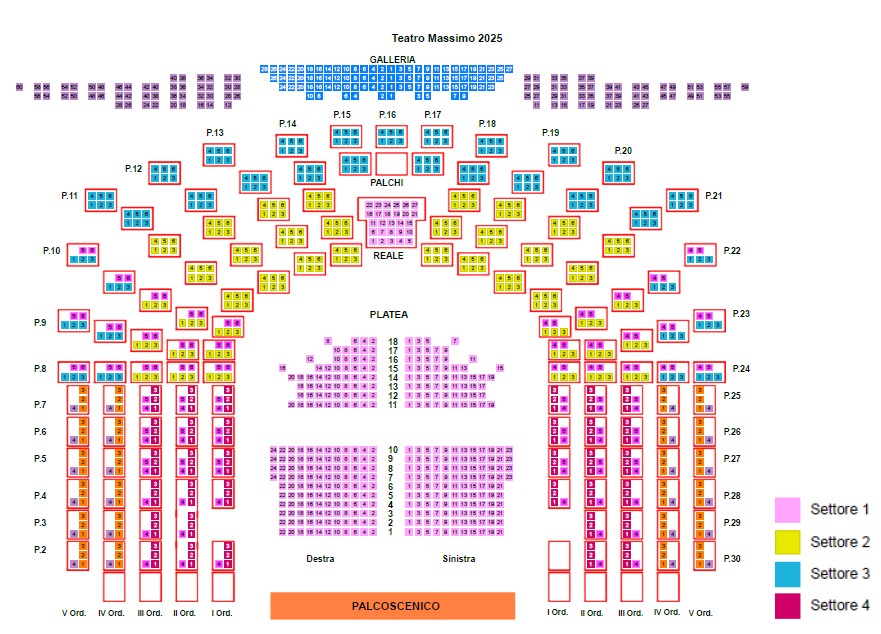

Teatro Massimo

The seating plan is given as an indication and has no contractual value.
The division of categories may differ depending on shows and dates.

Synopsis

Lucia di Lammermoor

LUCIA DI LAMMERMOOR, THE PINNACLE OF TRAGIC OPERA

Lucia di Lammermoor is a tragic opera in three acts composed in 1835 by Gaetano Donizetti. Donizetti's first tragic drama, this immensely successful opera is often regarded as the first masterpiece of Italian Romanticism. It is certainly Donizetti's most accomplished work, written at the height of his fame. A masterpiece of the tragic register, Lucia di Lammermoor is as much one of the greatest achievements of bel canto opera as it is of nascent Romanticism. The tragic drama was also the first work of the prolific librettist Salvadore Cammarano, who drew inspiration from the work of Walter Scott.

The action takes place on the Lammermuir moors in Scotland at the end of the 16th century. The backdrop is the conflict between Catholics and Protestants, with an impossible love in the foreground. Ashton's Protestant family has taken up residence in the ruined castle of the Ravenswoods, a rival Catholic family. The fiery love between Lucia Ashton and Edgardo Ravenswood runs completely counter to family loyalties...

Teatro Massimo

You may also be interested by …