

From €117
< Back to show details
Iphigénie en Tauride - Gluck

Teatro dell'Opera - Roma

Select the date of the show

Loading available dates...

Please specify your seating requests regarding your ticket booking (OPTIONAL).
(100 char. max)

Seating

Music & Opera books the best available seats. The exact location of your seats will be confirmed via email. Only adjacent seats can be booked. More information

ANY QUESTIONS ?

Contact us by tel: +33 1 53 59 39 29 – or by Email.) See Help & FAQ page

TICKET DELIVERY INFORMATION

Your E-tickets to be printed will be sent by mail.

Price

Music & Opera ticket prices differ from the ticket face value, as they also include all service fees and taxes.

The Club Music & Opera

Le Club Music & Opera
Join the Club to benefit from special offers. Already Member of the Club, Login !
Iphigénie en Tauride - Gluck

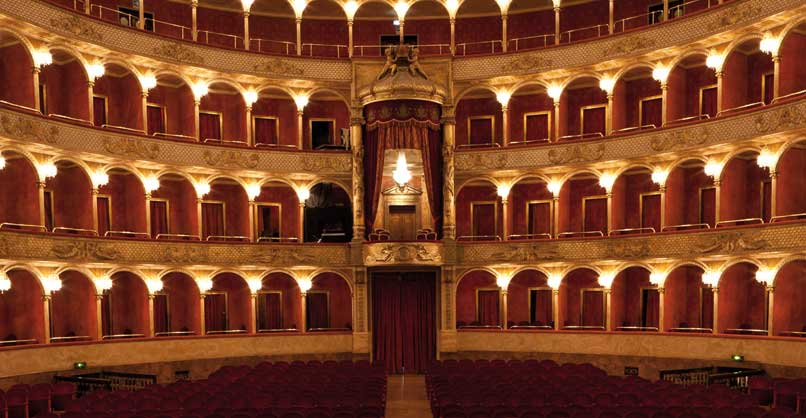
Teatro dell'Opera © Silvia Lelli

Gluck Iphigénie en Tauride

From 18 April TO 27 April 2027
Opening date: 08 October 2026
Teatro dell'Opera - Roma
From 117 €
Prices & Dates
Program

Gluck : Iphigénie en Tauride

Cast
  • Conductor
    Alessandro De Marchi
  • Director
    Robert Carsen
  • Performers
    Iphigénie: Axelle Fanyo
    Oreste: Alessio Arduini
    Pylade: Julien Behr
    Thoas: Jean-Fernand Setti
  • Venue Info
  • Seating Plan
  • Synopsis

Teatro dell'Opera - Roma LocationPiazza Beniamino Gigli, 7 - 00187 Roma Italie

  • Venue's Capacity: 1400

Even though there is proof that an opéra performance took place in Rome as early as 1606, (Agazzari's EUMELIO), the Pope's ban on théâtre and opéra performances was for many years an obstacle in the local development of opéra. In spite of the fact that a public opéra théâtre was inaugurated in 1697, no major composer was linked with the papal city until the opening of the présent opéra house in 1880. Opéra in Rome was far from inexistent during the nineteenth century: Rossini came to première his BARBER OF SEVILLE at the Teatro Argentina in 1816, and Verdi four of his works, including II TROVATORE (1853) and UN BALLO IN MASCHERA (1859) at the Teatro Apollo.

But in 1877, the city that had in the meantime become the capital of Italy was still without a modem opéra house. Domenico Costanzi, who had made a fortune in the hôtel business, had the good idea of bequeathing his name to the Eternal City by funding the construction of an opéra house, which was opened three years later. Roman operatic life was thus revived, and, from 1880 to 1926, the Teatro Costanzi hosted no less than 46 world premières and 120 Roman premières. Thèse premières, ail signed by Italian composers, included triumphant performances of Mascagni's CAVALLERIA RUSTICANA and Puccini's TOSCA. Furthermore, it was here that the Roman public discovered PARSIFAL in 1884, while Toscanini made his Roman début in the house's pit, conducting... CARMEN. In 1926. the théâtre fell into the hands of the fascist state, which renovated and modernized the building. When the house reopened two years later, rebaptized "Teatro Reale dell'Opera", the tradition of "national"premières was of course pursued, and one could hear composers such as Respighi and Malipiero, as weil as Stravinsky, Richard Strauss, and even Berg's WOZZECK in 1942. In 1937, the now famous open-air summer concerts were inaugurated in the Caracalla thermal baths.

In 1946, the institution adopted the name of Teatro dell'Opera and interna-tionalized its répertoire, while remaining faithful to contemporary music, as works by composers such as Britten, Honegger, Hindemith, Janâcek, and Henze were performed. It was also on this stage that Renata Tebaldi was applauded in 1948, and Maria Callas (in the rôle of Kundry in PARSIFAL!) in 1949. In spite offinancial difficulties, the house's artistic directors have, during these last few décades, deftly managed to keep alive the creativity and the luster of the Roman stage.
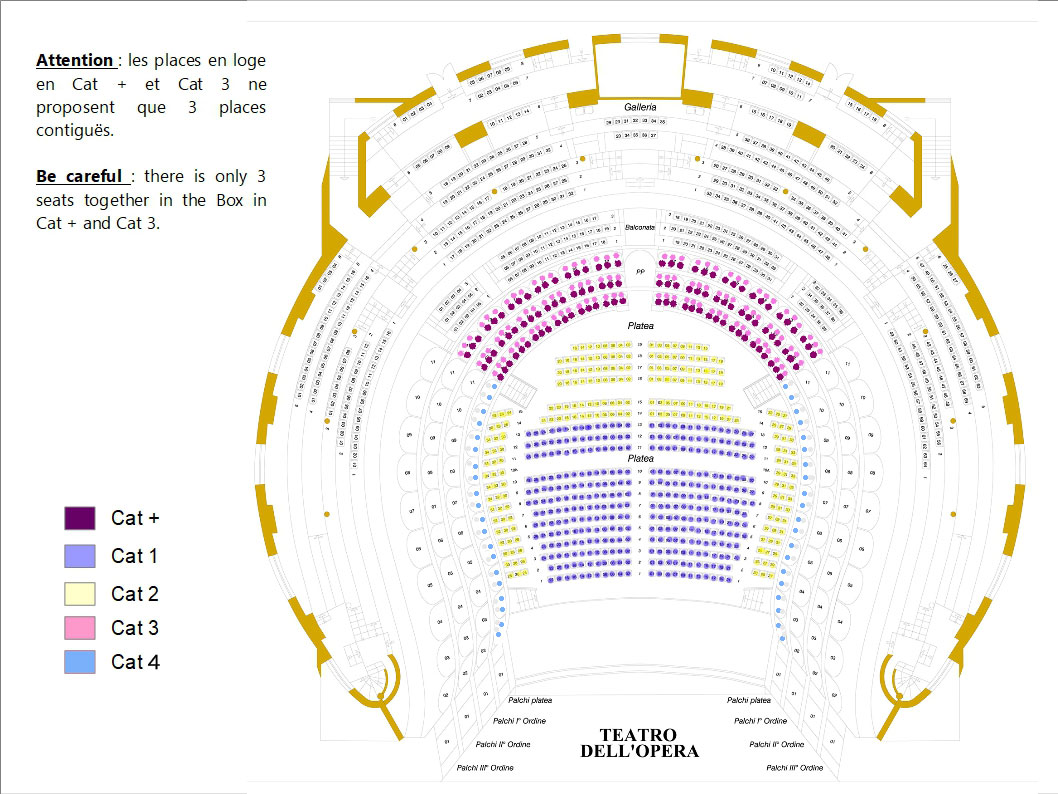

Teatro dell'Opera

The seating plan is given as an indication and has no contractual value.
The division of categories may differ depending on shows and dates.

Synopsis

Iphigénie en Tauride

IPHIGENIE EN TAURIDE TRIUMPH OF LIFE OVER TRAGEDY

Iphigénie en Tauride is an acclaimed libretto of famous French librettist Nicolas-François Guillard.
In collaboration with Christoph Willibald Gluck, Guillard made extensive changes to the play to suit Gluck's artistic vision. Gluck's Iphigénie en Tauride is widely acknowledged to be one of his finest piece of work.

HISTORY

Guillard is said to have been inspired by the ancient dramatist Euripides's play, Iphigenia in Tauris, to write this.

Act 1

The first act unfolds in Diana's temple in Tauris. It is a lull before an ominous storm. Iphigénie or Iphigenia is rescued by Diana and carried to Tauris when her father attempted to offer her as a sacrifice to Diana. Iphigenia is troubled by a nightmare she had. She very vividly saw her mother Clytaemnestra murdering her father, Agamemnon. Clytaemnestra in turn is murdered by Iphigenia's brother Orestes before succumbing to death by stabbings of Iphigenia. Meanwhile, Scythians find two shipwrecked Greek on their shore. Their secret mission is to take the statue of Diana back to Greece which they do not divulge. The two Greek are none other than Orestes and his friend Pylades.

Act 2

It is a Scythian custom to offer shipwrecked mortals as sacrifices on Diana's altar. Orestes and Pylades were chained and prepared for that. Orestes is not only ashamed to bring misfortune in his friend's life but is also tormented by the vision of Furies. Furies was killed by Orestes for assassinating his father, Agarmemnon. At this point Iphigenia enters. But the two did not recognise each other. Orestes is astonished by her likeness to his mother. Iphigenia, the high priestess of Diana, prepares for the funeral ceremony of Orestes with others.

Act 3

Orestes reminds Iphigenia the memories of her own brother. She wants him to carry the news of her survival to their sister Electra in Argos. She persuades Thoas, the Scythian king, to let one of the two captives survive and chooses Orestes to deliver the news. Orestes feels mortified at the thought of leaving behind his friend to die. After much requests, he persuades Iphigenia to let Pylades carry out the task.
Pylades leaves the scene vowing that he would save the life of Orestes.

Act 4

Iphigenia frets at the thought of killing Orestes. When she finally persuades herself to wield the knife Orestes cries out her name. The brother and sister reunite. Thoas enters and is enraged by the scene. Pylades comes with his Greek troop and kills Thoas. The Scythians get involved into a riot with the Greeks. At that moment Diana appears and asks the Scythians to restore her statue to Greece. She also forgives Orestes for killing his mother and asks him to send Iphigenia to her country. Everyone sings in chorus as the order is restored.

THE MAIN ROLES

Iphigénie, soprano or mezzo-soprano
Orestes, baritone
Pylade, tenor
Thoas, bass
Diana, soprano

Gluck used some of his own compositions and borrowed heavily from the other contemporary masters to embellish the adaptation of the play. He even utilised Johann Sebastian Bach's aria and used it into the portrayal of the story.

Teatro dell'Opera © Silvia Lelli

You may also be interested by …