

From €51
< Back to show details
Aida - Verdi

Palau de la Música - Barcelona

Select the date of the show

Loading available dates...

Please specify your seating requests regarding your ticket booking (OPTIONAL).
(100 char. max)

Seating

Music & Opera books the best available seats. The exact location of your seats will be confirmed via email. Only adjacent seats can be booked. More information

ANY QUESTIONS ?

Contact us by tel: +33 1 53 59 39 29 – or by Email.) See Help & FAQ page

TICKET DELIVERY INFORMATION

Your E-tickets to be printed will be sent by mail.

Price

Music & Opera ticket prices differ from the ticket face value, as they also include all service fees and taxes.

The Club Music & Opera

Le Club Music & Opera
Join the Club to benefit from special offers. Already Member of the Club, Login !
Aida - Verdi

Palau de la Catalana - Sala de Concerts @ A. Bofill

Verdi Aida

From 15 May TO 22 May 2027
Palau de la Música - Barcelona
From 51 €
Prices & Dates
Program

Verdi : Aida 160 mn

Sung in : Italian
Cast
  • Orquestra Simfònica del Vallès
  • Cor dels Amics de l'Opera de Sabadell
  • Conductor
    Andrés Salado
  • Director
    Esteve Gorina
  • Performers
    Aida: Carmen Solís
    Aida: Tina Gorina
    Radamès: Matheus Pompeu
    Radamès: Nacho Guzmán
    Amneris: Olga Syniakova
    Amneris: Laura Vila
    Amonasro: Ángel Ódena
  • Venue Info
  • Seating Plan
  • Synopsis

Palau de la Música - Barcelona LocationC/ Palau de la Música, 4-6 - 08003 Barcelona Espagne

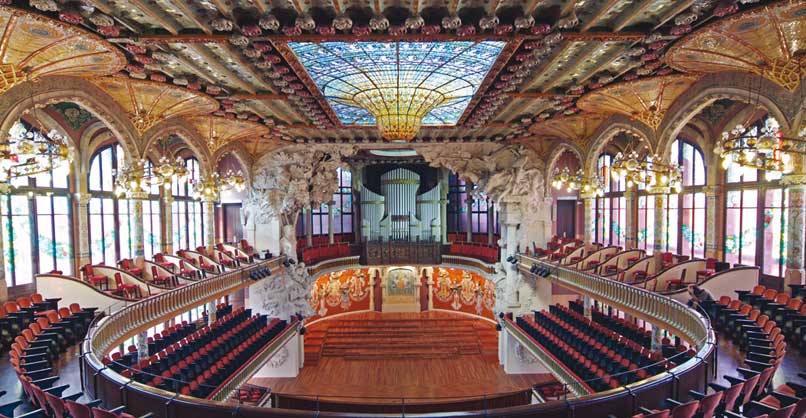
The architect Lluis Domenech i Montaner is the father of Catalonian "Modernismo," and the Palau de la Music a Catalana is his masterpiece. Together with Gaudi, Domenech i Montaner is a representative of the mixture of nationalism and unbridled invention that characterizes turn-of-the-century art in Barcelona, the equivalent of, for example, the French and Belgian "Art Nouveau", the Austrian "Jugendstil" and the English "Modern Style".

In 1891, Lluis Millet and Amadeu Vives founded the Orfeô Català, a chorale that performs both the Catalonian popular repertoire and serious polyphonic music. The succès of the chorale was such that they asked Domenech i Montaner to design office space and a concert hall for them. Up to this day, the Palau, inaugurated in 1908, has marked Barcelonas musical history. Amidst the building's coloured mosaics and its countless floral motifs, the Catalomans came legion to hear their Orfeö perform Bach's ST. MATTHEW PASSION (Catalonian premiere in 1921) and Beethoven's MISSA SOLEMNIS (performed to commemorate the centennial of his death in 1927). To mark these events, sculptures and bus reliefs were added to the already exuberant decoration. In the building's smaller chamber music theatre, as well as in the larger 2000-seat hall, with its luminous and extravagant glass ceiling in the form of an inverted coupola, the century's most prestigious artists have come to perform.

In 1921, for example, during the famous performance of Bach's PASSION, Albert Schweitzer played the German organ that is part of the hall's hemicycle (unfortunately, this organ has been abandoned since being poorly restored in 1973). Much to the architect's credit, the Berlin Philharmonic under Karajan's baton, as well as artists such as Rubinstein, Oistrakh, and Menuhin, not to mention the famous Catalonian singers Montserrat Caballé and Victoria de Los Angeles (locally called "dels Angels"), have kept alive this extraordinary edifice, that could be visited as a museum.

Declared a historical monument in 1971. the Palau was restored and extended between 1982 and 1989. In 1991-92, Orfeö Catalä's centennial celebrations, Barcelona again established its position amongst the world's major theatres, for Giulini, Temirkanov, Colin Davis, Muti, Mehta, Barenboim, and several others came here to conduct the Philadelphia, Leningrad, Berlin, Montreal, Dresden and London symphony orchestras.
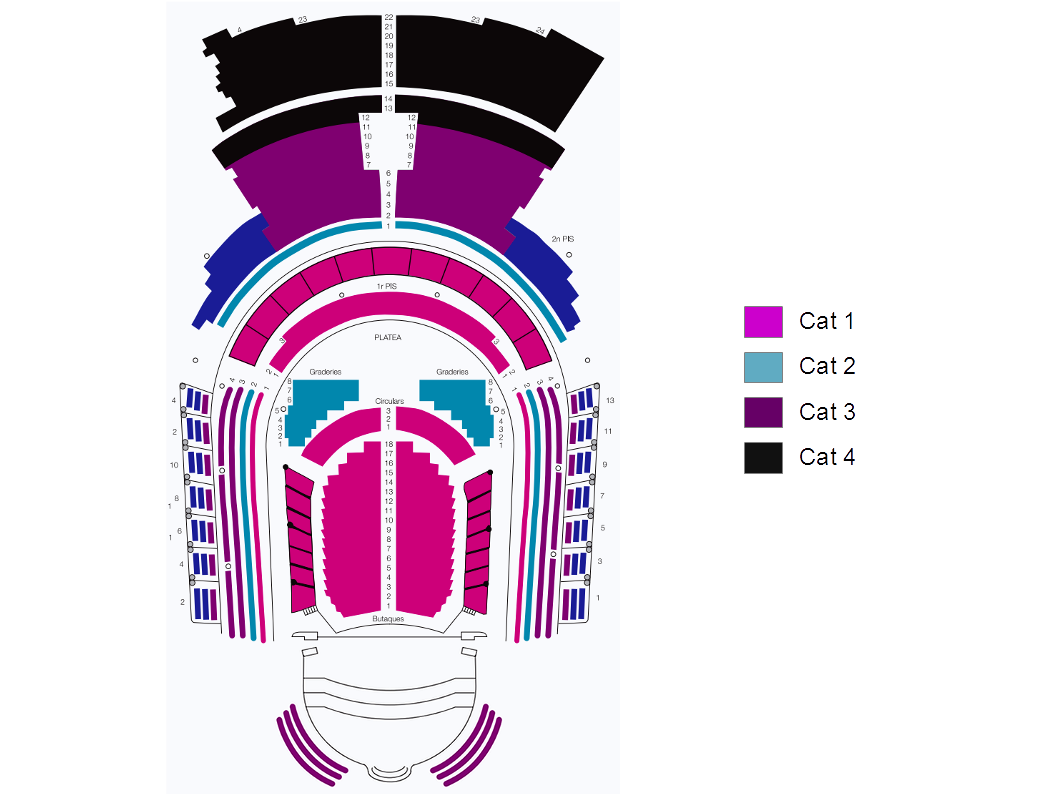

Palau de la Música

The seating plan is given as an indication and has no contractual value.
The division of categories may differ depending on shows and dates.

Synopsis

Aida

The grand decorum of Verdi's Aida should not obscure the fact that the intimate is at the heart of the work. 

A love story of infinite sweetness set against a political backdrop, the opera offers a wide range of emotions. As with all Verdi's masterpieces, only the greatest voices can do justice to the fabulous vocal writing.

Listen to the Music & Opera playlist : 

This opera in four acts is world-famous for its triumphal march (the trumpets of Aida), which sometimes makes us forget just how rich and complex Verdi's music is in this work. Often martial and emphatic in its accompaniment of victorious armies, it also conveys the torments of human passions: love, tenderness or jealousy...

Gentle and harmonious in the prelude to the first act, passionate and dramatic in the love scenes, the score becomes poignant to accompany the death of the lovers. In Egypt, at the time of the Pharaohs, the Ethiopian king Amonasro threatens to attack Thebes and the Nile valley. The young Egyptian captain Radames is in love with a pretty Ethiopian slave, Aida, but he does not know that she is Amonasro's daughter. For her part, Amneris, the Pharaoh's daughter, is infatuated with Radames. Jealousy and passion, against a backdrop of war and betrayal, lead to the deaths of Radames and the young slave girl.

MAIN CHARACTERS

  • Aida, Ethiopian slave girl, soprano.
  • Radames, Egyptian captain, tenor.
  • Amneris, daughter of Pharaoh, mezzo-soprano.
  • Amonasro, king of Ethiopia, baritone.
  • Ramphis, high priest, bass.
Palau de la Catalana - Sala de Concerts @ A. Bofill

You may also be interested by …

Pay in 3 installments 17,00€ with interest-free. Learn more