


From €0
< Back to show details
La Cenerentola - Rossini

Nationaltheater - München

Select the date of the show

Reservation on request at [email protected]
Specify the city, the date and the number of tickets required

Loading available dates...


Seating

Music & Opera books the best available seats. The exact location of your seats will be confirmed via email. Only adjacent seats can be booked. More information

ANY QUESTIONS ?

Contact us by tel: +33 1 53 59 39 29 – or by Email.) See Help & FAQ page

TICKET DELIVERY INFORMATION

Your E-tickets to be printed will be sent by mail.

Price

Music & Opera ticket prices differ from the ticket face value, as they also include all service fees and taxes.

The Club Music & Opera

Le Club Music & Opera
Join the Club to benefit from special offers. Already Member of the Club, Login !
La Cenerentola - Rossini

Cecilia Molinari © Alina Fejzo

Rossini La Cenerentola

From 13 June TO 20 June 2027
Nationaltheater - München
From 0 €
Prices & Dates
Program

Rossini : La Cenerentola 154 mn

Sung in : Italian
Cast
  • Bayerisches Staatsorchester
  • Bayerischer Staatsopernchor
  • Conductor
    Stefano Montanari
  • Director
    Jean-Pierre Ponnelle
  • Performers
    Angelina: Cecilia Molinari
    Don Ramiro: Dave Monaco
    Don Magnifico: Misha Kiria
    Dandini: Konstantin Krimmel
    Alidoro: Roberto Tagliavini
MUNICH MUSIC TRIP ON REQUEST

Attend to this performance within a complete Music Trip to Munich

More information and QUOTATION request below: 

For Munich Bayerische Staatsoper performances, we only offer PACKAGES : OPERA TICKET + HOTEL.

Contact us to as a quotation HERE

FIND HERE ALL MUSICAL STAYS

  • Venue Info
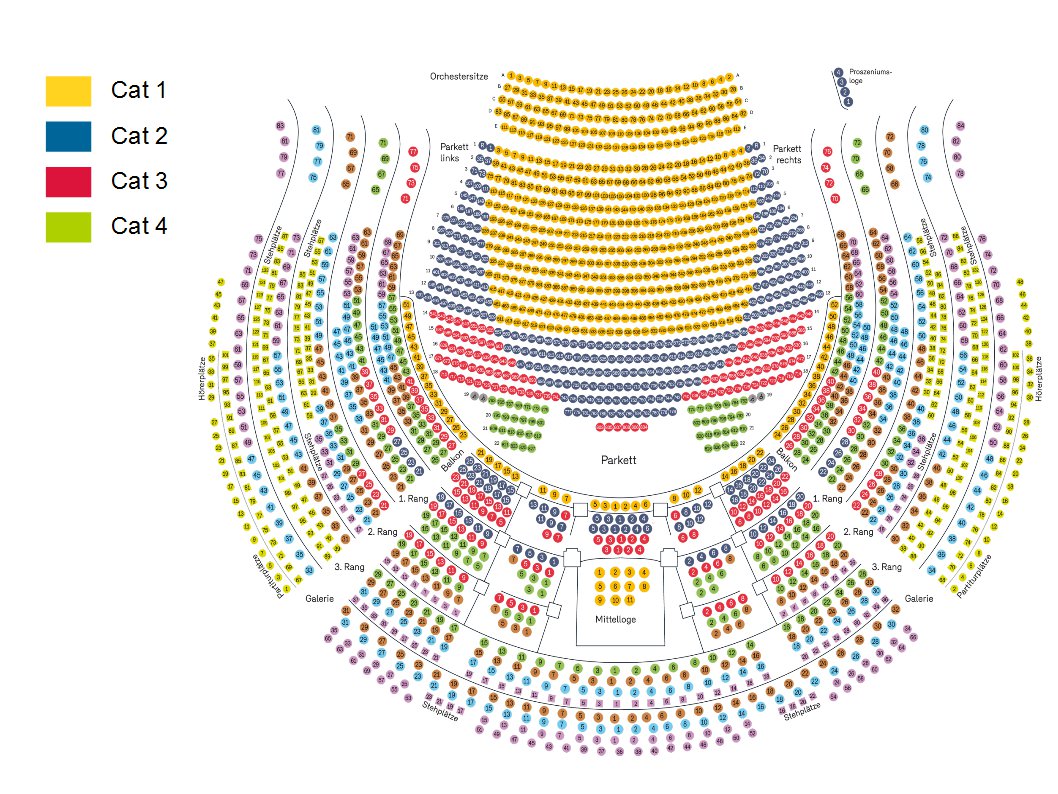
  • Seating Plan
  • Synopsis

Nationaltheater - München LocationMax-Joseph-Platz 2 - 80539 München Allemagne

  • Venue's Capacity: 2100

The history of Munich's actual theatre truly only begins at the end of the eighteenth century. Indeed, after over a century of infatuation for Italian opera, which was manifest in the construction of the Théâtre de la Cour (now called the Théâtre Cuvilliês, still active), local inhabitants began to feel the need for a German lyrical art. German repertoire, as Mozart appealed for, active in Munich especially during the premiere of his IDOMENEO, but also, a German theatre, since the Theatre de la Cour was limited to Italian art. The Napoleonic wars and King Maximilien I's sudden passion for the Odéon Theatre in Paris postponed this project.

The public thus waited until 1818 to discover its « National Theatre, » a subtle and luxurious synthesis of various styles: loggias in the Italian tradition cohabited with innovations from the French school of architecture. One of the noveltieswas a reservoir of water destined to be used in case of fire, but which nevertheless did not save the buildîng from flames in January 1823 ; the water was frozen! The Opera was reconstructed, financed by a special tax on beer: perhaps an original means but one yielding a particularly high return! After these rather tumultuous beginnings, the National Theatre reopened in 1825 and became the hotbed of German lyrical art. Four of Wagner's operas were premiered there between 1365 and 1870 (TRISTAN UND ISOLDE, Da MEISTERSINGER, DAS RHEINGOLD, and DIE WALKÜRE).

Wagner, of course, but also Mozart and Richard Strauss soon became the pillars of the Theatre's repertoire during the first half of the twentieth century, thanks to the talent of conductors such as Bruno Walter, Hans Knappertsbusch, and... Richard Strauss, himself a native of Munich. Strauss saw two of his operas premiered in his home town: FRIEDENSTAG (Peace Day, 1938!), and CAPRICCIO (1942). The libretto of the latter was elaborated with the help of the conductor Clemens Krauss, who was then Director of the Opera. The fact that the building was destroyed during the war did not prevent the company's tradition from being perpetuated.

Between 1952 and 1967, the institution was directed by Rudolf Hartmann, a former assistant to Richard Strauss and Clemens Krauss. The former 1818 edifice was reconstructed in 1963, after much hesitation as to whether or not to erect a modern hall. The long reign (1971-1992) of conductor Wolfgang Sawallisch, a distinguished representative of the tradition composed of rigour and commitment, is an example of the perserverance with which the Bayerische Staatsoper comes to terms with the legacy of its brilliant past.

Nationaltheater

The seating plan is given as an indication and has no contractual value.
The division of categories may differ depending on shows and dates.

Synopsis

La Cenerentola

Discover the upcoming dates for Rossini's opera, La Cenerentola, around the world and book your tickets now!

This retelling of the Cinderella story is the perfect playground for Rossini to express his talent and madness. It is a masterpiece in which directors often go to great lengths to convey the composer's whimsical universe. The work is one of the most spectacular in terms of vocals, offering golden roles for mezzo-sopranos and tenors.

Listen to the Music & Opera playlist : 

La Cenerentola is a drama giocosa written by Gioachino Rossini at the age of 25. It was first performed in January 1817 at the Teatro Valle in Rome. The libretto, written by Jacopo Ferretti, is based on Perrault's fairy tale Cinderella. However, Ferretti strips the work of its supernatural elements and changes a few details to portray a frail Cinderella, mistreated by her family but who triumphs thanks to her great kindness. 

The role of Angelina, alias La Cenerentola, was written for a coloratura contralto voice capable of great vocal agility, but it is often sung by mezzo-sopranos. The work is not lacking in humor, thanks to its comical situations, rapid dialogue, and character interactions.

THE STORY

The plot of La Cenerentola closely follows the story of Cinderella, the fairy tale by Perrault. Mocked by her stepsisters, the young and pretty Angelina believes she is in love with a young valet and goes to the ball. Dressed in her finest attire, she meets the Prince and flees after giving him not a glass slipper but a bracelet that will allow him to recognize her later. The masks come off, and kindness and love triumph!

MAIN CHARACTERS

  • Angelina, or Cenerentola, Don Magnifico's adopted daughter, contralto
  • Don Ramiro, Prince, tenor
  • Don Magnifico, Baron, bass
  • Dandini, Don Ramiro's valet, baritone
  • Tisbe, Angelina's half-sister, mezzo-soprano
  • Clorinda, Angelina's half-sister, soprano
Munich photo © Wiilfried Hösl

You may also be interested by …