

From €0
< Back to show details
Die Walküre - Wagner

Carnegie Hall (Stern Auditorium / Perelman Stage) - New York, NY

Select the date of the show

Reservation on request at [email protected]
Specify the city, the date and the number of tickets required

Loading available dates...


Seating

Music & Opera books the best available seats. The exact location of your seats will be confirmed via email. Only adjacent seats can be booked. More information

ANY QUESTIONS ?

Contact us by tel: +33 1 53 59 39 29 – or by Email.) See Help & FAQ page

TICKET DELIVERY INFORMATION

You will receive by mail your voucher to print and exchange at the theater.

Price

Music & Opera ticket prices differ from the ticket face value, as they also include all service fees and taxes.

The Club Music & Opera

Le Club Music & Opera
Join the Club to benefit from special offers. Already Member of the Club, Login !
Die Walküre - Wagner

Wagner Die Walküre

The 19 March 2027
Carnegie Hall (Stern Auditorium / Perelman Stage) - New York, NY
From 0 €
Prices & Dates
Program

Wagner : Die Walküre 260 mm

Sung in : German
Cast
  • Orchester der Oper Zürich
  • Conductor
    Gianandrea Noseda
  • Director
    Concert Version
  • Performers
    Siegmund: Klaus Florian Vogt
    Sieglinde: Vida Mikneviciute
    Wotan: Michael Volle
    Brünnhilde: Camilla Nylund
    Hunding: Mika Kares
    Fricka: Tanja Ariane Baumgartner
RESERVATION UPON REQUEST

For all reservation requests, please contact us by e-mail, specifying the city, the date and the number of tickets required at [email protected]

  • Venue Info
  • Seating Plan
  • Synopsis

Carnegie Hall (Stern Auditorium / Perelman Stage) - New York, NY Location881 7th Ave - NY 10019 New York, NY États-Unis

  • Venue's Capacity: 2.804

On April 22, 1887, a young American conductor, Walter Damrosch, sailed from New York to study in Europe. During the crossing, he made the acquaintance of steel magnate Andrew Carnegie and began to discuss with him the idea of giving New York a prestigious international concert venue worthy of the city. And so, New York's legendary Carnegie Hall was born.

On its inauguration on May 5, 1891, Carnegie Hall opened under no lesser figure to conduct Damrosch's orchestra than Tchaikovsky. All of America's major orchestras went on to guest at the Hall and, soon, New Yorkers became accustomed to applauding the world's greatest conductors: from Gustav Mahler to Leonard Bernstein, including Toscanini, who conducted no fewer than twenty-eight seasons.

The world's greatest pianists were soon to follow: Paderewsky, Rachmaninoff and Rubinstein, who not only made his debut there in 1906 but also gave his farewell concert in 1976; Horowitz and Van Cliburn were also acclaimed there, as was a pianist little known in 1973, Alfred Brendel. To mention the artists who have scored resounding triumphs at Carnegie Hall would be to draw up a list of the century's greatest international stars, from Caruso to Pavarotti, Fritz Kreisler to Isaac Stern, not forgetting Yasha Heifetz who, aged 16, made his debut in the midst of the Russian Revolution.

It is the sheer endurance of Carnegie Hall rather than its dazzling beginnings that astounds. From the very outset, William Steinway, of Steinway and Sons, had publicly voiced his doubts as to the Hall's profitability. But Andrew Carnegie, as a shrewd entrepreneur, had taken a number of precautions. For instance, the power generator that supplied Carnegie Hall also sold electricity to the City of New York on non-performance evenings. In spite of such measures, the Hall's financial situation gradually deteriorated until March 31,1960, the date on which the walls of the famous Hall were scheduled to be razed. It was saved, however, thanks mainly to the efforts of Isaac Stern, who succeeded in rounding up a group of sponsors. The violinist remains titular chairman of Carnegie Hall to this day. In the past, he has regularly organised impressive gala performances. In 1976, for instance, Isaac Stern, Yehudi Menuhin, Dietrich Fischer-Dieskau and Leonard Bernstein performed the HALLELUJAH Chorus from Handel's MESSIAH.

Today, Carnegie Hall still proudly plays host to the Vienna and Berlin Philharmonic Orchestras on their rare tours of the U.S. More than a New York concert venue, Carnegie Hall is a world shrine to music. And just as Walter Damrosch had once hoped, it is the place where international reputations are made...
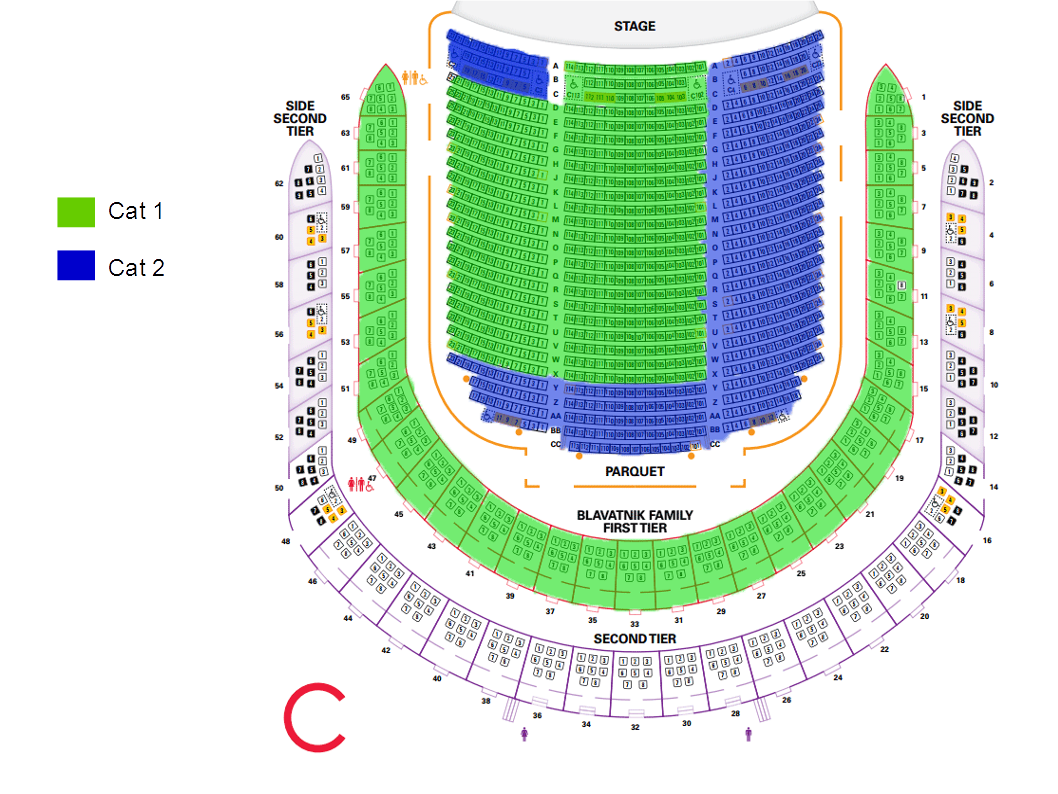

Carnegie Hall (Stern Auditorium / Perelman Stage)

The seating plan is given as an indication and has no contractual value.
The division of categories may differ depending on shows and dates.

Synopsis

Die Walküre

Discover the upcoming dates for Wagner's opera Die Walküre around the world and book your tickets now!

THE VALKYRIE, WAGNER'S MASTERPIECE

Although Die Walküre is Wagner's most famous work, it is part of the Ring cycle, a unique and most ambitious collection of compositions ever written. Some 15 hours of superlative music illustrate an epic and brilliant story of men and gods, dominated by the immortal figures of Brünnhilde, Wotan and Siegfried.

This opera is the first of the three days that make up the Ring of the Nibelung cycle and takes place after the prologue, Das Rheingold (The Rhine Gold). This major work by Richard Wagner is inspired by Germanic mythology and the Nibelungenlied, a medieval German epic poem. It premiered in Munich in 1870. Throughout the tetralogy, as in Die Walküre, recurring musical themes characterise the characters and situations. These leitmotifs give the Nibelungen cycle its thematic and musical unity.

HISTORY

The Valkyries are warrior maidens, daughters of Wotan, father of the gods. The plot of the opera also features two twin demigods, Siegmund and Sieglinde, who become bound by an incestuous love. The work explores the complex interplay of feelings, guilt and punishment, in the purest romantic tradition. The characters' destinies unfold against the fabulous backdrop of Germanic mythology.

THE MAIN CHARACTERS

  • Siegmund, twin brother of Sieglinde and son of Wotan, tenor
  • Sieglinde, twin sister of Siegmund, soprano
  • Hunding, husband of Sieglinde, bass
  • Wotan, father of the gods, bass-baritone
  • Brunnhilde, daughter of Wotan, soprano
  • Fricka, goddess guardian of marriage, mezzo-soprano
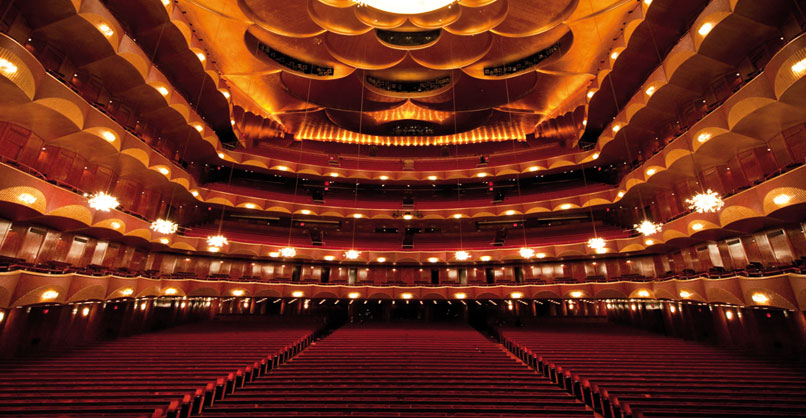
Carnegie Hall (Stern Auditorium) © Jeff Goldberg/Esto

You may also be interested by …