


vanaf € 221
< Revenir au détail du spectacle
Aida - Verdi

Teatro di San Carlo - Napoli

Choisissez la date du spectacle

Beschikbare datums worden geladen...


Stoel locatie

Music & Opera reserveert de beste beschikbare plaatsen. de exacte plaats zal per e-mail worden bevestigd. Alleen plaatsen naast elkaar worden geboekt.Meer informatie

VRAGEN?

Neem contact met ons op via tel: +33 1 53 59 39 29 - of per e-mail) Zie Hulp & Vragen

TICKETS VERKRIJGEN

Ontvangt u electronische entreebewijzen om uit te printen afdrukken of op uw smartphone opslaan.

Prijs

De Music & Opera-prijs komt niet overeen met de nominale waarde van het ticket en bevat alle toepasselijke kosten en belastingen.

De club Music & Opera

Le Club Music & Opera
Word lid van de Club voor Profiteren van de prijzen Al lid van de Club, log in!
Aida - Verdi

Netrebko Anna © Rubio Dalmau Olga

Verdi Aida

De 06 september 2026
Teatro di San Carlo - Napoli
vanaf 221 €
Tarifs & Dates
Program

Verdi : Aida 160 mn

Gezongen in : in het Italiaans
Cast
  • Orchestra e Coro del Teatro di San Carlo
  • Dirigent
    Riccardo Frizza
  • Regisseur
    Concert Version
  • Vertolkers
    Aida: Anna Netrebko
    Radamès: Jonas Kaufmann
    Amneris: Elizabeth DeShong
    Amonasro: Luca Salsi
    Ramfis: Alexander Köpeczi
    Il Re: Andrea Pellegrini
  • Info salle
  • Plattegrond van de zaal
  • Synopsis

Teatro di San Carlo - Napoli LocationVia San Carlo, 98F - 80132 Napoli Italie

  • Capaciteit 1386

The "San Carlo" is the world's oldest opera house still in activity. Right from the start, in 1737, people came from far and wide to admire the theatre's excellent 42-musician orchestra, and to applaud the castratos trained at the Naples Conservatory (like the famous Farinelli), as well as divas known by their nicknames, "la Parruchierrina," or "la Bastarella," for example. And the house in itself, with its sumptuous architecture and no less than six stories of boxes, was no minor attraction: Stendhal was enchanted by the hall's charm, and Paul Klee was fascinated by what he described as this "superb, heavy, and obscure theatre."

In 1816, fire burned down the theatre, and Ferdinand de Bourbon reconstructed an identical building with amazing speed, for Naples, robbed of its opera house, was plunged in mourning, and threatened to not support its sovereign. Let's not forget that at that time, the reign of Domenico Barbaja (nicknamed "The Prince of Impresarios" by Alexander Dumas) had already begun brilliantly. In 1815. this Milanese ex-cafe waiter, who is often credited with the invention of whipped-cream, had had the brilliant idea of hiring Gioacchino Rossini in person as the theatre's artistic director. This exceptional LUCIA DI LAMMERMOOR for the San Carlo), while launching, in 1826, a young composer called Vincenzo Bellini. The Neapolitan stage became the place where several singers' careers were made or broken; the famous French tenor Adolphe Nourrit, for example, who considered that the applause had not been sufficient, commited suicide after a performance at the San Carlo. The composer Saverio Mercadante then won the favours of the San Carlo's notorious audience, to such an extent that Verdi at first felt ill at ease in the theatre. Only to better triumph in 1872, when he organized an entire season, and had an orchestra pit added.

During the twentieth century, the stars of the Scala have sometimes overshadowed those of the San Carlo, an historic rivalry that has always existed, in a country where music lovers must choose sides. But the Neapolitan stage defends itself by ever enriching, even to this day, the world's largest repertoire of works ever premiered in an opera house, while legendary singers, such as Beniamino Gigli (who performed in the theatre from 1915 to 1953), have always remained exceptionally faithful to the San Carlo audience, which also happens to be one of the warmest anyone could imagine.
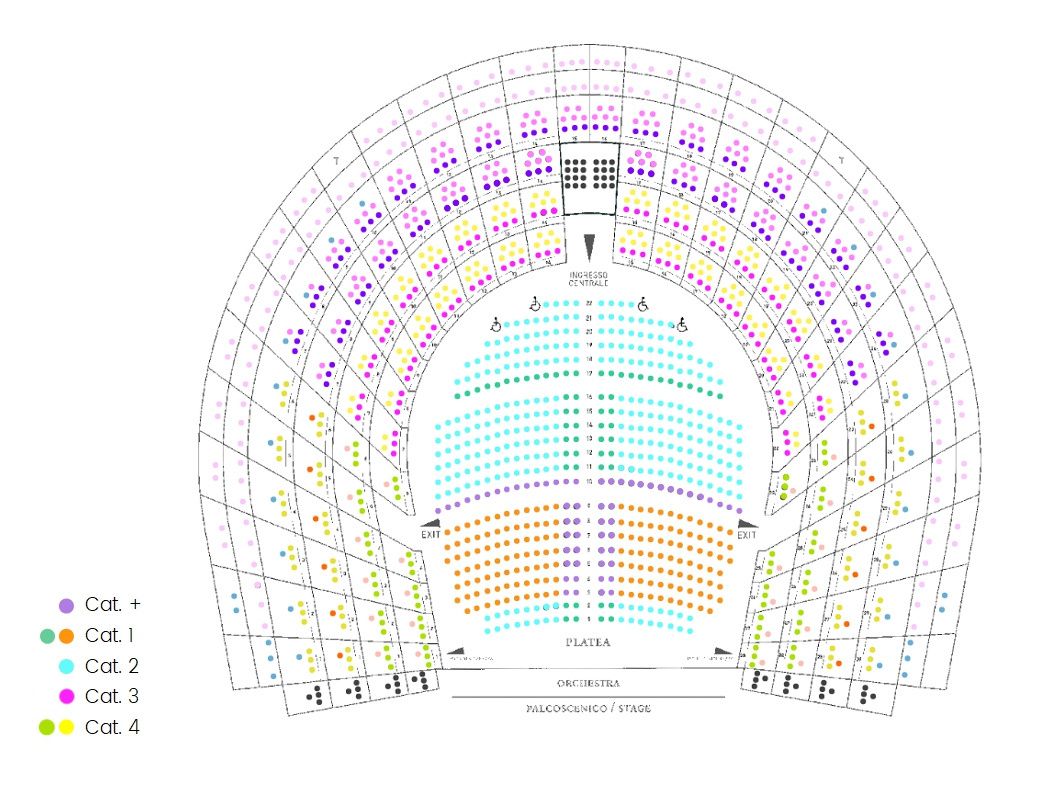

Teatro di San Carlo

De plattegrond is indicatief en heeft geen enkele contractuele waarde.
De indeling van de categorieën kan verschillen, afhankelijk van voorstellingen en data.

Synopsis

Aida

Het grootse decorum van Aida mag niet verhullen dat het intieme de kern van het werk vormt.

Een liefdesverhaal van oneindige zoetheid tegen een politieke achtergrond, de opera biedt een breed scala aan emoties. Zoals met alle meesterwerken van Verdi kunnen alleen de beste stemmen recht doen aan het fantastische vocale werk.

Luister naar de afspeellijst Music & Opera :

Deze opera in vier bedrijven is wereldberoemd om zijn triomftocht (De Trompetten van Aida), waardoor we soms vergeten hoe rijk en complex Verdi's muziek in dit werk is. Vaak krijgshaftig en nadrukkelijk in zijn begeleiding van zegevierende legers, drukt het ook de kwellingen van menselijke passies uit: liefde, tederheid of jaloezie...

Zacht en harmonieus in het voorspel van de eerste akte, gepassioneerd en dramatisch in de liefdesscènes, wordt de partituur aangrijpend om de dood van de geliefden te begeleiden. In Egypte, ten tijde van de farao's, dreigt de Ethiopische koning Amonasro Thebe en de Nijlvallei aan te vallen. De jonge Egyptische kapitein Radames is verliefd op een mooie Ethiopische slavin, Aida, maar hij weet niet dat zij Amonasro's dochter is. Amneris, de dochter van de farao, is op haar beurt verliefd op Radames. Jaloezie en passie, tegen een achtergrond van oorlog en verraad, zullen leiden tot de dood van Radames en de jonge slavin.

HOOFDPERSONAGES

  • Aida, Ethiopische slavin, sopraan.
  • Radamès, Egyptische kapitein, tenor.
  • Amneris, dochter van de Farao, mezzosopraan.
  • Amonasro, koning van Ethiopië, bariton.
  • Ramphis, hogepriester, bas.
© Teatro di San Carlo

U bent mogelijk ook geïnteresseerd in…

Payez en 3 fois 73,67€ avec sans intérêt. Lees meer